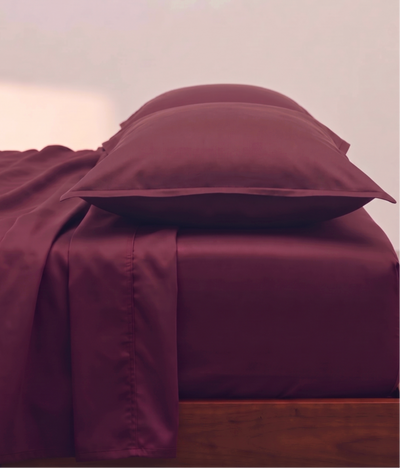
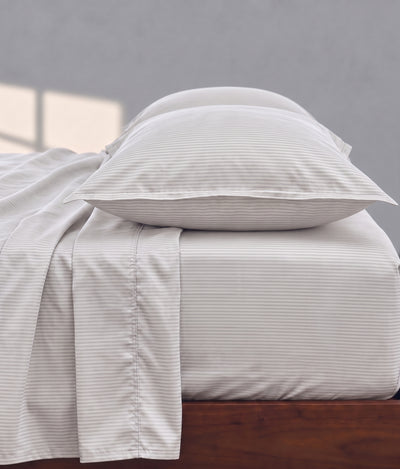
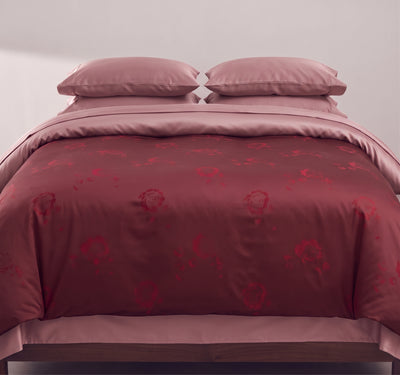


Steeped in nature.
Methodology


Color, the older way.
Most bedding is colored in an afternoon. Reactive dyes, synthesized from petroleum, bonded to fiber in a hot alkaline bath — fast, cheap, and identical everywhere it's done. It is a genuinely impressive chemistry. It is also where most of the industry's harshness lives: the high-pH processing that roughens a smooth fiber, the residues that certifications exist to police, the sameness of a color that never knew a season.
We went the other way. Every shade in our botanic collection begins as something you could hold in your hand — a rind, a root, a flower, a mushroom. It takes longer. It is worth it.
The ingredient list.
Ten ingredients color the entire collection. Pomegranate rind for our deepest reds. Eucalyptus — the same tree our fiber comes from — for soft greens and greys. Indigo for blues. Annatto for warmth. Beetroot for pinks, hibiscus for blush, ginger for gold, pomelo rind for citrus yellows, porcini for our browns, calcite to steady the palette.
That is the whole list. We publish it because we can.
Why it feels different.
Lyocell begins as one of the smoothest fibers ever made — under a microscope, a clean cylinder where cotton is a twisted ribbon. Conventional reactive dyeing spends some of that smoothness: hot, alkaline processing coaxes the fiber's surface into fibrillation, a fine roughening you can't see but your skin can find. Plant dyeing works gentler and cooler. It doesn't add softness — nothing does. It declines to take it away. The softness you feel is the fiber's own, arrived intact.
What isn't in it.
Every piece in the collection is certified OEKO-TEX® Class I — the standard written for babies under three, the class most bedding isn't. Not because our sheets are for infants, but because the standard is the strictest one that exists, and eight hours a night against your skin seemed like reason enough to meet it.
The honest caveats.
Plant color is alive in ways synthetic color is not. Shades vary slightly between dye lots, the way no two pomegranates match. They mellow gradually across years of washing rather than holding a frozen brightness. We consider this the point. If you want a color that never changes, synthetic dyes are genuinely better at that, and we'd rather tell you so than pretend otherwise.

Porcini

Calcite

Pomelo Rind

Ginger

Eucalyptus

Pomegranate

Gardenia

Indigo

Beetroot

Hibiscus
The Collection
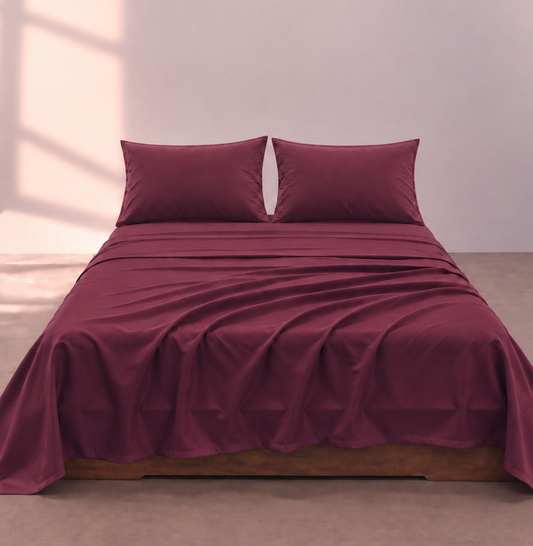
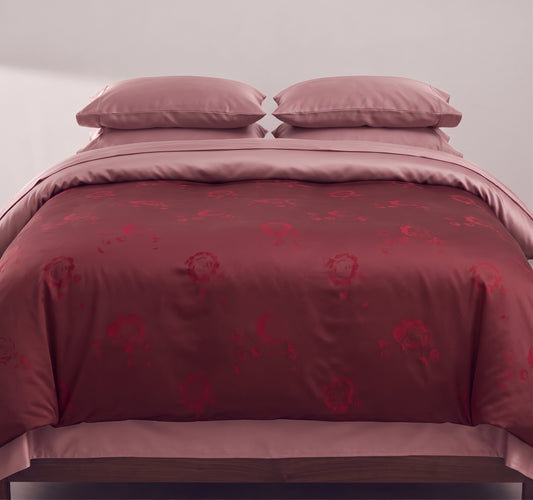
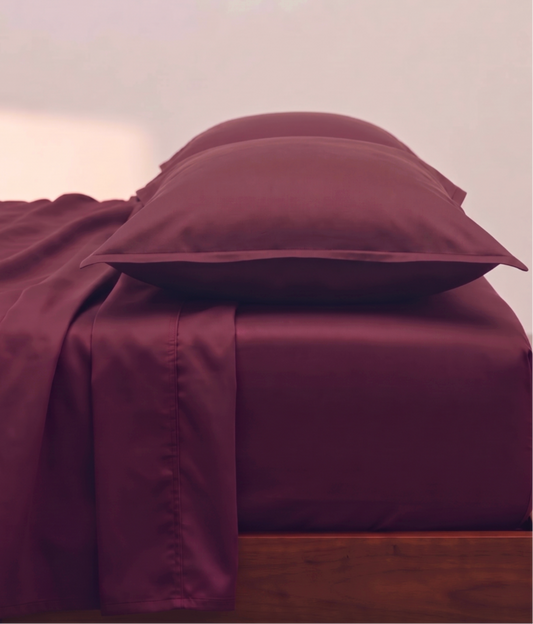

Noteworthy
Our natural-dye colorways are produced by exhaust dyeing with botanical dyestuffs, using a process documented and controlled at every stage.
1. Preparation. Fabric is scoured to remove residual waxes and pectins, then pre-treated with a tannin bath to open the fiber for uniform uptake.
2. Mordanting. The fabric is mordanted using plant tannins and naturally occurring mineral salt that bonds dye molecules to the fiber. We use no iron, copper, chromium, or tin mordants.
3. Extraction. Dye is extracted from whole plant material — madder root (Rubia tinctorum), pomegranate rind (Punica granatum), weld, indigo, walnut hull, gardenia leaf, pomegranate, pomelo rind and more — by controlled hot-water extraction, filtered before use.
4. Dyeing. Fabric is dyed in the botanical bath with pH held to fix shade. Each dye lot is matched to a physical master standard; because botanical dyes vary by harvest, lot-to-lot variance of minimal ΔE tolerance is occasionally accepted as an identifying characteristic of the craft led, natural process.
5. Fixation and washing. Dyed fabric is rinsed to clear water and neutralized. No synthetic fixatives, resins, or optical brighteners are applied at any stage.
6. Testing. Every lot is tested for colorfastness to washing [ISO 105-C06 / AATCC 61], rubbing [ISO 105-X12], and light [ISO 105-B02], and certified to OEKO-TEX Standard 100 Class I. Test Results: read more.