
Do Linen Sheets Actually Keep You Cool?
Key takeaways:
There's a particular kind of frustration in hot sleeping. The sheets cling to damp skin. The pillow flips for a cooler side that doesn't exist. By 3 a.m., you're back online: "Are linen sheets cooling? Will they actually work? Are they worth the money?"
The short answer to these questions: yes, they do, provided you pick the right ones.
Linen breathes, absorbs sweat without becoming immediately wet, and stays cool to the touch in dry climates. It has earned its summer reputation for real, measurable reasons.
But not every linen sheet set cools the same. The flax source, weight, and finish all decide whether a set actually delivers on what linen can do.
For sleepers who've already cycled through "cooling" sheets that disappointed, the difference between a linen set that performs and one that doesn't comes down to a few specifics most brands don't explain.
Here's what to look for.
Why Linen Sheets Are Genuinely Cooling
Linen's cooling reputation comes from the flax fiber itself.
Cotton cools by absorbing sweat into tightly packed cotton fibers. Synthetic blends cool by sitting cold against the skin until body heat catches up. Linen cools through its structure: the way the fiber is built and how it's woven into fabric.
- Hollow fiber structure: Each flax fiber is hollow at the core with thick, porous walls. Air passes through the fiber itself. That's the fiber-level reason linen sheets are known for cooling the moment you slide in.
- Open, low-thread-count weave: Linen is typically woven with thicker yarns at lower thread counts (80 to 150). The looser interlock leaves microscopic gaps that continuously channel airflow. Higher thread counts in linen actually reduce cooling because density traps heat. Lower is better for hot weather.
- High moisture absorbency: Linen pulls sweat into the fiber before the surface becomes damp. Evaporation moves heat off the skin, and the surface stays comfortable for hours as the night warms.
- Year-round temperature regulation: Linen is also an effective cool-weather fabric. The same hollow structure that cools in summer adds light insulation when the room runs cool. Linen bedding is one of the rare fabric categories that works across seasons.
Linen is an excellent choice for anyone looking for cooling sheets that breathe, absorb, and last. The next question is how to pick a set that delivers on the fiber's potential.

How to Get the Most Cooling from Linen Sheets
Not all linen sheets cool equally. Three variables decide whether a set is suitable for hot sleepers, and they're easy to check before buying.
Look for Belgian Flax
Grown in the European linen-growing region, Belgian flax produces longer, finer fibers than most other origins.
Look for "Belgian linen" or "Belgian flax" stated explicitly on the label. A generic "100% linen" tag doesn't tell you where the flax came from.
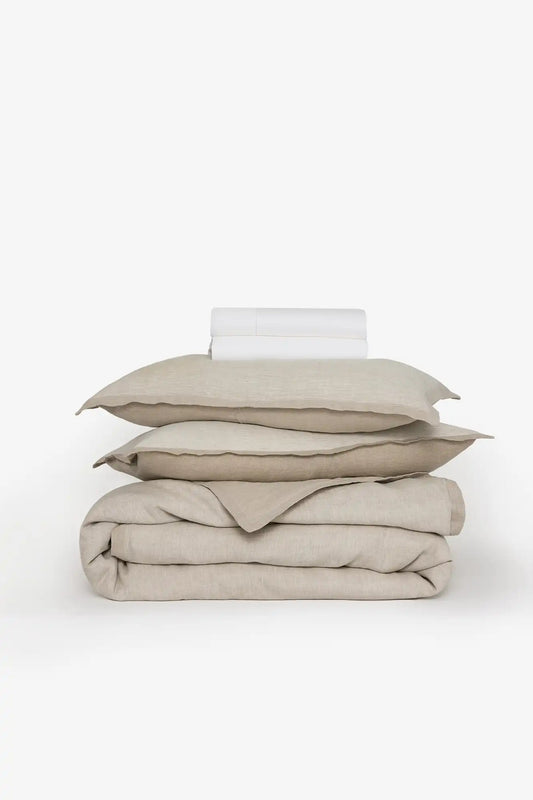
Buffy's Belgian Linen Sheet Set is one example of Belgian flax done right: finer fiber, softer hand, longer-lasting than budget linen.
Pick a Lighter-Weight Linen
Linen sheets come in a range of weights.
Lighter weights breathe more freely and move more air across the fabric surface, which is what you want for hot sleeping and warm-climate bedrooms. Heavier weights are substantial and add warmth, which works for cooler seasons but reduces summer cooling.
Quality linen is often labeled 'lightweight' or 'summer weight,' or described by GSM (grams per square meter). These terms are reliable shorthand for the breathable end of the linen range and a great choice for hot sleepers.
Skip Silicone-Finished and Heavily Treated Linen
Some lower-priced linens are finished with silicone or wrinkle-resistant coatings to soften them in the box. These coatings reduce the fiber's moisture absorption and airflow, which is what makes linen cooling in the first place. Untreated, well-washed pure linen breathes properly.
When choosing the right sheets, look for terms like "100% flax," "pure linen," or "unfinished linen" on the label. Heavily marketed "easy-care" linen often comes with a hidden cooling cost.
How Linen Compares to Other Cooling Sheets
Linen sets a real cooling benchmark: passive, structural, fiber-level cooling that lasts. But plenty of the bedding category promises the same thing without delivering.
Some use chemical coatings that wash out. Some are softer marketing than fiber. Here's how linen stacks up against three common cooling sheets on the market.
PCM-Coated "Cooling Sheets"
Most cooling sheets at mid-market price points use Phase Change Materials, or PCM: microencapsulated wax applied as a topical finish to register cold on first contact. Wash by wash, that coating breaks down. After 10 to 20 cycles, the cooling sensation is gone, and the base fabric is left doing whatever it would have done on its own. This is science-washed cooling: cold sold as performance, delivered by a coating that doesn't last. Linen's cooling lives in the fiber, so it outperforms PCM-coated sheets from the first month of washing onward.

Bamboo Viscose Sheets
Bamboo viscose, sometimes called bamboo rayon, is processed using a chemical solvent that breaks the bamboo plant down and rebuilds it into a fiber. The resulting yarn is soft and moisture-wicking out of the box. But with regular washing, it pills faster than linen, and in lower-quality production, chemical residue from the solvent can remain in the fabric. That early softness is what gets bamboo marketed as a linen alternative for breathability. But the comparison only holds up as long as the yarn does. For hot sleepers, linen's fiber durability makes it a safer cooling investment.

Polyester and Microfiber Blends
At the cheapest end of the cooling-sheet market sit synthetic fibers: polyester, microfiber, or blends of both. They're hydrophobic, which means they don't pull moisture in. Sweat stays on the skin, and the cool sensation these sheets register on first touch turns into trapped heat by the middle of the night. For hot sleepers, this is the lowest-performing category on the market. Across the board, linen holds its cooling reputation against alternatives that don't.
The Linen Investment Worth Making
Most cooling sheets are a marketing category, but linen has been a fabric for centuries, long before "cooling sheets" existed.
When the linen is well-made and the chemistry is clean, the cooling shows up the first night and keeps showing up for years.
For hot sleepers, for sleepers managing night sweats, for anyone who's run through "cooling" sheets that didn't deliver, linen earns its place in the summer bed.
If you're ready to outfit the whole bed in linen done right, Buffy's linen bedding collection covers sheet sets, duvet covers, pillowcases, and shams. Every piece is built to OEKO-TEX® STANDARD 100 CLASS 1, the highest chemistry tier in textiles.
Choose well, and you stop shopping for cooling sheets.
Frequently Asked Questions (FAQs)
Yes. Linen has a hollow-fiber structure, a loose weave, and high moisture absorption that pulls sweat off the skin before it can saturate the surface. In dry climates and at lighter weights, linen sheets are among the coolest fabrics available for summer bedding.
Belgian flax is the premium fiber tier: longer, finer, and more consistent than most other origins. For hot sleepers in dry or mild climates, Belgian linen is the best option.
For hot sleepers who run extremely hot all night, TENCEL™ lyocell is the fiber-based alternative engineered for continuous cooling. Buffy's Breeze Sheet Set is woven from 100% eucalyptus-derived TENCEL™ lyocell, which wicks 50% more moisture than cotton and achieves a Qmax ≥.224 per FTTS-FA-019 (cotton typically sits around 0.13). Tencel stays cool because of what it is. Not because of what we added to it.
Depends on the climate and sleep style. Cotton percale has a crisper first-touch hand and washes consistently. Linen has a more open weave and absorbs more moisture. For hot summer nights, linen runs cooler. For a smooth, classic bed look, cotton percale is the move.
Linen is a strong choice for night sweat management. The fiber pulls sweat off the skin and into the fabric, keeping the bed drier through the cycles of heat and cooling that come with night sweats. Peer-reviewed clinical research on moisture-managing bedding (Montgomery et al.) showed 52% sleep quality improvement and 53% faster sleep onset over 8 weeks. For nights that involve waking up damp, look for the lightest-weight Belgian linen set and a breathable duvet to match.
Linen still cools in humid weather, just less dramatically than in dry heat. The fabric absorbs moisture into its fibers and pulls heat away from the skin through evaporation. When ambient humidity is high, evaporation slows, so the surface cooling is less pronounced. In humid summers, the lightest-weight linen sets perform best, and pairing linen sheets with a fan or air conditioning enhances cooling.
For hot sleepers, a quality linen set is one of the more durable cooling bedding investments. A well-made Belgian linen set lasts five to 10 years with normal care, gets softer with every wash, and doesn't lose cooling performance as it ages. Compared to “cooling sheets” that wear out in one to two summers, the cost per summer of cooled sleep is significantly lower over time.
