
How TENCEL™ Lyocell Backs Up Its Breathable Promise
Key takeaways:
Every bedding brand calls its fabric breathable. The word has been doing a lot of work in marketing copy over the last decade, often without much specificity behind it.
So when the claim shows up on a TENCEL™ lyocell label, the question is whether the term is doing real work or just sitting there decoratively.
Is TENCEL™ breathable? Yes, and the answer has receipts.
The fiber absorbs 50% more moisture than cotton, moves vapor 2.5 times faster, and stays measurably cooler against the skin on first contact (more on each of these later).
The cooling is structural, built into the fiber's geometry, and doesn't wash out the way coating-based cooling does.
For anyone tired of being told "breathable" without evidence, the rest of this article is the proof.
What Is TENCEL™ Lyocell?
TENCEL™ is the brand name for lyocell fiber produced by Lenzing AG, an Austrian textile company that holds the trademark and certifies the production standards.
The fiber starts as wood pulp, harvested primarily from sustainably grown eucalyptus, with smaller volumes from beech and spruce trees. The pulp is dissolved in a non-toxic solvent and spun into fiber through a closed-loop process that recovers more than 99% of the solvent for reuse.
The output is a smooth, round-section cellulose fiber that handles moisture differently from other plant-based fibers.
The fiber's surface allows water to move in and out more quickly than cotton, which is why TENCEL™ has become the bedding industry's go-to for moisture management.
It also takes dye cleanly and resists wrinkles without needing chemical finishes that interfere with airflow.

How TENCEL™ Lyocell Breathes
TENCEL™ lyocell breathes through three distinct mechanisms: how much sweat it absorbs, how fast it releases vapor, and how cool it conducts against the skin.
Each one is measurable, and each one outperforms cotton on the same tests.
Moisture Absorption at the Fiber Level
TENCEL™ lyocell absorbs 50% more moisture than cotton. The fiber's internal structure contains nanoscale channels that pull moisture into the core of the fiber, away from the skin's surface.
This matters at a specific point in the night: the moment sweat starts forming.
Cotton holds absorbed moisture closer to the fabric surface, where evaporation works on a slower timeline. TENCEL™ draws the moisture inward immediately, which keeps the sleep surface dry through the hours that matter most for sleep quality.
Vapor Flux for Continuous Heat Release
Absorption is one half of breathability. The other half is the release rate, the speed at which the fabric expels the vapor it has taken in.
TENCEL™ lyocell drives 2.5× higher vapor flux than cotton, which means heat and humidity exit the bed continuously through the night. This is the property most bedding marketing misses.
A fabric can absorb sweat well and still hold heat if vapor releases slowly. The fiber matches absorption with release, which is why the bed stays cool past hour three of sleep.
Cool to the Touch by Measurement
The third mechanism is surface conductivity, measured as Qmax under FTTS-FA-019.
TENCEL™ lyocell scores ≥.224 compared to cotton's approximately 0.13. The higher the number, the cooler the fabric registers against the skin in the first moments of contact.
This is the measurement that matches the cool-to-touch claim most cooling sheets make in marketing copy.
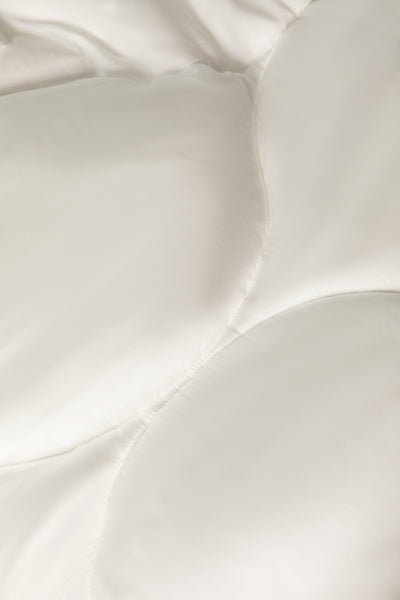
Buffy's Breeze Comforter is woven from 100% eucalyptus-derived TENCEL™ lyocell, engineered to deliver this kind of measurable cooling from the moment you slide under it.
How TENCEL™ Lyocell Compares to Cotton
Cotton is the bedding default for a reason. It's been the textile industry's most common natural fiber for centuries, with thousands of weave variations refined for different uses.
TENCEL™ lyocell is a newer fiber category designed specifically for moisture management.
The honest comparison isn't cotton vs lyocell as categories. It's which cotton variant you're comparing, and how it performs against TENCEL™ on the variables that matter for sleep.
Weave Decides Cooling More Than Fiber Type
Cotton's performance varies dramatically by weave.
Percale (one-over, one-under) is the lightest, coolest cotton weave and the closest cotton match to TENCEL™ on airflow.
Sateen is denser and warmer, made for a polished bed-finish look but less suited to hot sleepers.
TENCEL™ lyocell is most often spun into a sateen weave that stays cooler than cotton sateen because the fiber's moisture properties offset the weave density.
Fiber Length Affects Softness and Durability
Long-staple cottons produce softer, smoother, more durable sheets with less linting than short-staple cotton.
Buffy's Supima cotton bedding collection uses 100% extra-long-staple US-grown cotton in a percale weave for this reason. TENCEL™ lyocell is engineered as a long-staple fiber from the start, with smoother filaments that resist pilling.
Lifespan With Nightly Use
A well-made long-staple cotton percale sheet set lasts three to five years of regular use with proper care.
TENCEL™ sheets perform comparably and often longer because the smooth fiber surface doesn't fray as quickly. However, TENCEL™ requires gentler washing than typical cotton.
Environmental Footprint
TENCEL™'s closed-loop manufacturing recovers more than 99% of its solvents, and the wood pulp comes from sustainably managed forests.
Cotton's environmental footprint varies by farming method, with long-staple varieties like Supima often grown to higher sustainability standards.
Both fibers are biodegradable at the end of life.
Best Fit by Sleeper Type
Cotton percale fits sleepers who want a crisp, classic finish and don't typically run hot.
TENCEL™ lyocell fits hot sleepers, those who wake up damp, or anyone wanting the smoothest possible surface against sensitive skin.

Does TENCEL™ Lyocell Contain Microplastics?
The question comes up because TENCEL™ doesn't move or look like a typical plant fiber.
The smooth surface and silk-like drape resemble polyester. The name "lyocell" sounds industrial. The production process involves a chemical solvent. All of which makes it reasonable to wonder whether the fiber sheds plastic when it sheds. It doesn't.
TENCEL™ lyocell is a cellulose-based fiber made from wood pulp. The material sits in the same plant-based category as cotton and linen: biodegradable and free of plastic fragments.
This matters during washing. Synthetic fabrics like polyester shed microplastic fragments with every wash cycle, which then enter waterways and accumulate in the environment.
When TENCEL™ sheds fibers during washing, those fibers are cellulose. They break down in soil and water within months, just like other plant matter.
For sleepers who already audit chemical exposure in their household, TENCEL™ also carries OEKO-TEX® STANDARD 100 Class 1 certification, the strictest tier in textiles, which screens against more than 1,000 harmful substances.
The fabric is radically clean by design across both material and chemistry.
How to Care for TENCEL™ Lyocell
TENCEL™ lyocell tolerates standard washing more easily than silk or fine cotton, but the same care steps that preserve any quality fabric apply here, too.
- Wash cold or warm, never hot: Hot water can weaken cellulose fibers over time. Tumble dry low for the gentlest finish.
- Skip bleach and fabric softener: Bleach degrades the fiber's surface. Fabric softener leaves a coating on the fiber that reduces moisture management performance.
- Treat stains promptly with cold water and an enzyme-based stain remover: Avoid optical brighteners in detergent, which can dull the fabric's color and texture.
The breathability lives in the fiber itself, so care that protects the fiber protects the breathability. With proper handling, TENCEL™ holds its cooling performance through hundreds of washes.
What Truly Breathable Bedding Looks Like
For most bedding fabrics, "breathable" is a vibe. For TENCEL™ lyocell, it's a measurement.
That difference matters most when you're standing between two sheet sets with the same word on both labels.
One measures up on the textile-science breathability tests. The other usually doesn't.
Without verifiable numbers behind the marketing language, the only way to know which is which is to buy it, sleep on it, and judge.
Most hot sleepers have already spent enough rounds on that exact experiment.
For sleepers ready to stop guessing, Buffy's bedding is engineered around TENCEL™ lyocell breathability from sheets to comforters. The fiber does the cooling work, and it doesn't wash out.

Frequently Asked Questions (FAQs)
Yes. TENCEL™ lyocell ranks among the textile category's top performers for hot sleepers. The fiber absorbs 50% more moisture than cotton, drives 2.5× higher vapor flux, and registers cool against the skin. The bed stays drier and cooler through the night, which is why lyocell sheets are a reliable cooling pick for sleepers who wake up damp.
No. TENCEL™ lyocell is a cellulose-based fiber made from wood pulp, not a synthetic polymer. When the fabric sheds fibers during washing, those fibers are biodegradable cellulose that break down in soil and water like other plant matter. Synthetic fabrics like polyester shed plastic fragments with each wash. TENCEL™ does not.
Both are breathable, but TENCEL™ lyocell measures higher on the textile-science breathability tests. The fiber absorbs 50% more moisture than cotton and moves vapor 2.5× faster. Cotton percale specifically is a breathable cotton option with a more open weave than sateen. For hot sleepers, lyocell delivers more consistent moisture management.
TENCEL™ lyocell typically costs more per sheet set than conventional cotton. The fiber requires gentler care than fully synthetic blends, though it tolerates standard machine washing without specific care steps. Aggressive treatment, like very hot water or harsh detergents, can shorten the lifespan of the fiber's smooth surface and reduce its moisture-management performance over time.
Yes. TENCEL™ lyocell is cellulose-based and biodegradable in both soil and marine environments. Under standardized industrial composting conditions, the fiber breaks down within months. This contrasts with synthetic fabrics like polyester, which persist for centuries. The fiber's biodegradability is one reason it has become the textile industry's go-to for eco-conscious bedding.
