What Are the Best Cooling Sheets for You?
A practical guide to cool-to-touch feel, airflow, moisture handling, fabric, weave and the evidence behind cooling claims.
Cooling sheets can make a bed feel less warm, but “cooling” is not one feature. Some fabrics move heat away quickly when your skin first touches them. Some constructions allow more air to move through the bed. Some fibers interact with moisture, while other technologies are designed to buffer temperature changes. The best cooling sheets for you depend on what wakes you up: trapped heat, perspiration, a clammy feel or all three. This guide explains the mechanisms, the evidence to look for and the feel, fit and care trade-offs that turn a cooling claim into a confident choice.
The 30-second answer
The best cooling sheet is the one whose mechanism matches your main source of discomfort. Start with what you actually notice at night, then look for evidence that measures that problem.
-
Warm the moment you get into bed: look for a qualified contact-cooling test, such as Qmax, run on the finished fabric. Remember that a cool first touch is not an all-night result.
-
Comfortable at first, but too warm later: look at fabric weight, weave, density and the other layers on the bed. A fiber name by itself does not tell you how much air moves through a finished sheet.
-
Damp or clammy by morning: look for evidence about moisture uptake, liquid transport and drying. Those properties are connected, but they are not interchangeable.
-
Not sure which problem you have: choose a balanced construction, a feel you enjoy and a trial or returns policy that lets you test the sheet with your real mattress, protector and bedding.
What cooling sheets can—and cannot—do
Cooling sheets are sheets designed to influence one or more parts of the sleep surface: how cool the fabric feels at first contact, how heat and air move through the construction, how the material handles moisture, or how an added technology absorbs and releases heat.
They do not operate like air conditioning. A sheet cannot refrigerate the room, and a contact or moisture test should not be treated as proof that the product lowers core body temperature. The experience also depends on the mattress and protector, duvet or blanket, sleepwear, room temperature, humidity and the sleeper.
Four terms are especially useful when comparing products:
-
Cool-to-touch describes the initial sensation when skin meets the fabric. It is mainly a contact-heat-transfer question.
-
Breathable should describe how a finished construction allows air or vapor to move—not merely the plant or polymer from which the fiber began.
-
Moisture-managing can refer to uptake, transport or drying. A useful claim specifies which of those was measured.
-
Temperature-buffering describes technologies intended to absorb and release heat across changing conditions. It is not the same as active refrigeration.
Start with your real sleep problem
“I sleep hot” can describe several different experiences. Separating them prevents you from chasing the biggest percentage on a product page when a different mechanism would be more relevant.
If warmth builds without much sweating, examine the complete construction. Low fabric weight does not guarantee high airflow: weave, yarns, density and finishing all shape the finished structure, while a heat-trapping protector or duvet can dominate the wider bed system. Look for finished-fabric information rather than assuming a fiber is automatically airy.
If you wake damp or clammy, ask how the material interacts with moisture. Moisture regain, wicking and drying answer different questions: how much moisture a conditioned material holds, how liquid moves through a fabric and how quickly moisture leaves it. The way the sheet feels when damp may matter as much as the headline number.
If the bed feels warm as soon as you lie down, contact-cooling evidence may be useful. If surface feel is your concern, compare smooth with textured, crisp with silky and structured with drapey.
Most hot sleepers have a combination problem. In that case, balance contact feel, construction, moisture evidence, preferred hand feel and the rest of the bed instead of treating one laboratory number as the whole answer.
|
Main need |
What to look for |
Evidence question |
Trade-off to keep visible |
|---|---|---|---|
|
Cooler first touch |
A qualified contact-cooling test |
Was Qmax or an equivalent test run on the finished fabric? |
Initial sensation is not an all-night result. |
|
Less clammy feel |
Moisture uptake, transport and drying information |
Was fiber uptake, liquid movement or drying actually measured? |
These are related, but they are not the same property. |
|
Less trapped heat |
Lightweight construction, airflow and lighter bedding layers |
Was airflow tested on the finished fabric or only inferred from the fiber name? |
Fiber content alone does not determine airflow. |
|
Confidence after washing |
Care directions plus wear or pilling evidence |
Which method, duration and endpoint were used? |
A laboratory rating is not a lifetime guarantee. |
How sheets create a cooler-feeling sleep surface
Cooling sheets generally work through four pathways. A product may use more than one, and no single test proves performance across all four.
These pathways must not be combined into one score or translated into one another: Qmax is not airflow, moisture regain is not wicking or drying, and none of those fabric tests alone establishes an overnight or body-temperature outcome.
Contact heat transfer
When skin first touches a sheet, heat begins moving between the two surfaces. Some finished fabrics transfer heat away from the skin faster at that initial moment, creating a cooler sensation. Qmax is one way to measure that initial transfer under a defined setup. It does not, by itself, describe airflow, sweat transport or what happens several hours later.
Air movement and construction
A sheet is more than its fiber. Yarn size, weave or knit, density, fabric weight and finishing help determine how the finished construction behaves. The protector beneath the sheet and the bedding above it are part of the same system. That is why “made from a breathable fiber” and “the finished sheet has measured airflow” are not equivalent claims.
Moisture interaction
A material may take up moisture, move liquid along or through its structure, and release moisture as it dries. Each process can affect comfort, especially in humid conditions or for people who perspire, but each requires its own evidence. Moisture uptake should not be casually rewritten as wicking, drying or a body-temperature result.
Added cooling technologies
Some products use finishes, coatings, embedded particles or phase-change materials to create or amplify a cooling function. These approaches should be evaluated by the same standard as any other mechanism: what was added, what outcome was tested, whether the finished product was measured and how performance changed after laundering or wear. It is not accurate to assume that every added technology washes away or that every fiber-level property lasts forever.
Fabric and construction trade-offs
Material names are useful starting points, not automatic performance scores. Construction, finishing and product-specific testing still decide how a sheet feels and performs.
Lyocell and TENCEL™ Lyocell
Lyocell sheets are commonly chosen for a smooth, drapey hand and a moisture-comfort route to cooling. TENCEL™ is a branded lyocell fiber, not a generic promise that every TENCEL™ sheet will perform identically. Check the fiber percentage, finished construction, product-specific testing and care directions. This route may suit someone who prefers a silkier surface rather than a crisp or heavily textured one.
Cotton percale
Percale describes a weave, not a cotton species or a laboratory result. It is generally associated with a crisp, structured hand that some sleepers prefer when they dislike cling or a very fluid drape. Compare yarn, fabric weight and finishing rather than relying on thread count alone. A higher thread count is not automatically cooler, and a lower count is not automatically better made.
Linen
Linen offers a more textured, relaxed surface and a character that changes with washing and use. Shoppers who like visible texture and a less polished drape may value that feel; shoppers looking for a very smooth or uniform surface may not. Product construction, weight and care still matter, so linen should not be treated as an automatic winner for every hot sleeper.
Bamboo-labelled sheets
“Bamboo” often describes the plant source rather than the finished fiber. Check whether the label says viscose, rayon or lyocell, then evaluate the weave, weight and evidence for the actual product. Two sheets marketed with the same plant name may use different processes and constructions, so the front-of-pack word is not enough to predict cooling or durability.
Engineered synthetics and phase-change products
Synthetic fibers, blends and phase-change systems can be designed for specific heat or moisture functions. The useful questions are practical: what is the intended mechanism, was the finished sheet tested, what comparator was used and was performance checked after care? Avoid treating “synthetic,” “coated” or “natural” as a substitute for evidence.
Feel remains a real decision criterion. Crisp versus silky, light versus substantial, smooth versus textured, and structured versus drapey can determine whether you enjoy sleeping on the sheet even when two products make similar cooling claims.
How to read a cooling claim
A trustworthy claim lets you see the measurement and its limits. Before comparing two numbers, ask five questions:
-
What was measured—initial heat transfer, airflow, moisture uptake, wicking, drying, temperature buffering or something else?
-
Was the sample a raw fiber, a fabric swatch or the finished sheet sold to customers?
-
Under what temperature, humidity, pressure or conditioning requirements was the test run?
-
What was the comparator, and was it tested under the same method and setup?
-
What did the test not measure?
Qmax describes the maximum rate of heat transfer at initial contact under a specified method. When two fabrics are tested comparably, a higher result can correspond to a cooler initial sensation. It should not be shortened into “stays cooler all night” or a claim about core body temperature.
Moisture regain describes how much moisture a conditioned material holds at equilibrium relative to its dry mass under stated conditions. It is not the same as liquid wicking, drying time or the temperature of a finished sheet. A percentage difference in regain must remain a percentage difference in regain.
The strongest evidence block keeps the standard or method, laboratory, sample, conditions, result, units and limitation together. Moving the limitation to a footnote makes the claim harder—not easier—to understand.
A worked example: how Breeze evidence should be read
Once the mechanism and evidence questions are clear, a product claim becomes easier to evaluate. Breeze can be presented as one worked example—not as a universal ranking.
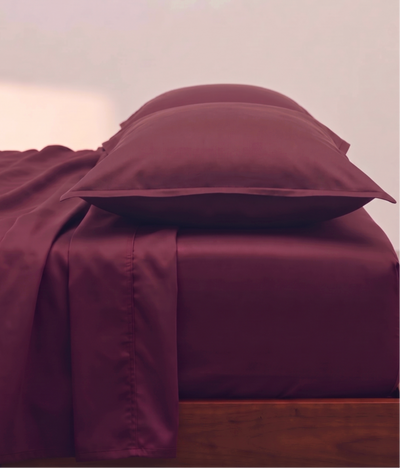
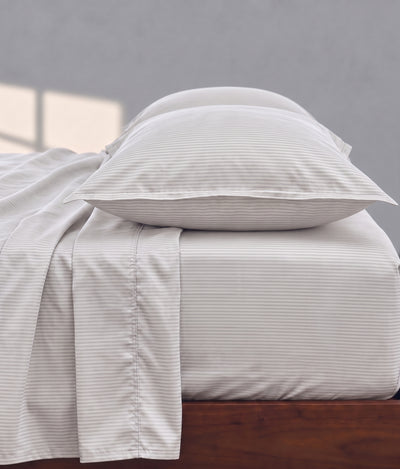
Breeze is woven from 100% TENCEL™ Lyocell, a cellulosic fiber derived from responsibly sourced wood.
That composition identifies the material route. It does not establish that every lyocell sheet behaves the same way, so the finished-product and fiber evidence should remain separate.
In Intertek testing under FTTS-FA-019, finished Breeze fabric achieved a Qmax of 0.405 W/cm². Higher Qmax indicates faster initial heat transfer from the skin to the fabric.
Qmax describes initial contact heat transfer—the cool-to-the-touch moment. It is not a measurement of body-temperature reduction, an all-night temperature result or a ranking against another product.
In peer-reviewed fiber testing at 20°C and 60% relative humidity, lyocell measured 9.23% equilibrium moisture regain versus 5.54% for cotton—approximately 67% higher. This was a controlled fiber test, not a measurement of finished-sheet temperature.
The difference describes equilibrium moisture regain. It should not be read as 67% cooler, more breathable, drier or more sweat-wicking.
Hohenstein testing using ASTM methods observed first thread breakage at 18,000 abrasion rubs under ASTM D4966-22, a 4.0–5.0 pilling-resistance rating after 60 minutes under ASTM D3512, and tear strength of 10.4 lbf warp and 6.4 lbf weft under ASTM D1424.
Laboratory results are not a promise that the sheet will never pill, tear or wear in household use.
A separate chemical-safety check
Breeze is certified to OEKO-TEX® STANDARD 100 Product Class I—the standard's strictest product class, designed for textiles used by babies and children up to age three.
This is a chemical-safety certification, not cooling evidence.
A separate editorial recognition
In its 2026 guide, House Beautiful named the Buffy Breeze Sheet Set its “Best Overall Cooling Sheets” pick.
This is third-party editorial recognition, not a scientific performance result or a universal category ranking.
The useful conclusion is not that one test settles the category. It is that each result answers a defined question. Readers can then decide whether initial contact feel, moisture behavior, construction, durability evidence and preferred hand feel match what they need.
Your cooling-sheet buyer checklist
-
Name the discomfort: warm first touch, trapped heat, perspiration, clamminess—or a combination.
-
Match the mechanism: check that the test measures the problem you are trying to solve.
-
Choose the feel: crisp or silky, structured or drapey, smooth or textured.
-
Check the construction: fiber content, weave or knit, weight and density—not thread count alone.
-
Confirm fit and contents: mattress depth, elastic or anchor system, flat sheet, pillowcases and size-specific differences.
-
Read the care directions: washing, drying, stain treatment and any durability evidence should be visible before purchase.
-
Use the 50-night return window in your real room: test the sheet with your mattress, protector, duvet and normal sleepwear.
Buffy offers a 50-night risk-free return policy beginning on delivery. Review the current return terms before ordering.
The best choice is the one you can explain
Choose the mechanism that matches your problem, then choose the feel you will enjoy sleeping on. A useful cooling claim names what was tested and keeps the limitation close to the result. Finally, check fit, care, set contents and return terms so the sheet works with the bed you actually own. Compare the Best Sheets for Hot Sleepers for Buffy product selection, the Breeze Sheet Set and Breeze Fitted Sheet for current SKU details, How Cooling Sheets Work for technical evidence, Cooling Sheets for Night Sweats and Hot Flashes for the specialist use case, and How to Wash Cooling Sheets and Reduce Pilling for care.
Frequently asked questions
What are the best cooling sheets for hot sleepers?
There is no universal winner. Start with whether you struggle most with warm first contact, trapped heat, sweat or a clammy surface. Then compare the mechanism, product-specific evidence, construction and feel. A sheet you enjoy touching and can test in your real bedding system is more useful than an unsupported category ranking.
What material is coolest for sheets?
Fiber, yarn, construction, weight, finishing and the rest of the bed work together. Lyocell, cotton percale, linen and engineered systems offer different routes and feels, but a material name alone does not establish a universal winner. Compare the finished product and the evidence behind its claim.
Do cooling sheets stay cold all night?
No sheet can guarantee that. A cool-to-touch effect may be strongest when skin first meets the fabric. Comfort later in the night also depends on airflow, moisture, room conditions and bedding layers. Look for claims that distinguish the initial sensation from ongoing heat and moisture management.
Are TENCEL™ or lyocell sheets good for hot sleepers?
They can be a useful option for shoppers who want a smooth, drapey feel and are interested in moisture comfort. But the trademark or fiber name is not the whole product. Check the percentage, construction, finished-product evidence, care directions and how the specific sheet feels to you.
Should a Qmax result affect which cooling sheet I buy?
It is relevant if your main problem is a warm first touch and the finished products were tested under comparable methods and conditions. It should not decide the purchase by itself, because Qmax does not establish airflow, moisture transport, overnight cooling or a change in body temperature.
Can I use a moisture-regain percentage as a cooling percentage?
No. Moisture regain is equilibrium moisture held relative to dry mass under stated conditions. It is not a measurement of finished-sheet temperature, liquid wicking, drying speed or sleeper temperature. Keep the result attached to the property the test actually measured.
Is a higher thread count cooler?
Thread count alone is not a cooling score. Yarn, weave, density, fabric weight and finishing all matter, and thread-count methods are not always directly comparable. Treat it as one construction detail rather than the headline answer.
Are cooling sheets useful for night sweats?
Sheets may support heat and moisture comfort, but they should not be presented as a treatment or a guarantee that sweating will stop. Focus on the relevant mechanism and evidence, and use Cooling Sheets for Night Sweats and Hot Flashes for a more specific decision framework.
How should I wash cooling sheets?
Follow the care label for the specific product. Washing and drying recommendations vary by fiber, construction and finish. Do not assume that normal laundering destroys every added technology or permanently preserves every fiber-level property; use product-specific care and durability evidence. See How to Wash Cooling Sheets and Reduce Pilling for the product-specific care framework.
Should I buy a sheet set or only a fitted sheet?
Choose based on how you make the bed. A set may suit someone replacing the fitted sheet, flat sheet and pillowcases together. A fitted sheet may suit someone who does not use a flat sheet or wants to mix materials. Confirm the exact size-specific contents and fit details before deciding.